Cardano Hard Fork Expected Next Month, Leios Still ‘This Year’: Hoskinson

bitcoinistОпубліковано о 2026-02-20Востаннє оновлено о 2026-02-20

Анотація

In a February 19 livestream, Charles Hoskinson announced that the Cardano blockchain is expected to undergo a hard fork "next month," while the Leios scalability solution remains on track for release "this year." He highlighted several key developments, including the upcoming launch of the Midnight network, a LayerZero integration connecting Cardano to over 80 blockchains, and the introduction of USDCx—a stablecoin-like asset emphasizing privacy and non-freezability. Hoskinson also discussed ongoing ecosystem growth, such as Plutus upgrades, Aiken development, and the integration of Pyth as a tier-one oracle. Additionally, he expressed concerns about the industry's shift toward permissioned networks controlled by financial institutions, warning against centralized control over user assets. At the time of reporting, ADA was trading at $0.2748.

Charles Hoskinson said Cardano is tracking toward a hard fork “next month,” while the long-discussed Leios scalability work remains on schedule for “this year,” in a Feb. 19 livestream recorded after a trip through Japan and a stop at Consensus in Hong Kong.

Hoskinson framed the next few weeks as a convergence point for two parallel roadmaps: Cardano’s protocol and developer-stack upgrades on one side, and the Midnight network launch he expects “coming next month” on the other, an effort he described as unusually difficult to execute even for teams with prior experience shipping major chains.

Cardano Momentum: Midnight, LayerZero And USDCx

In the livestream, Hoskinson spent his opening stretch recapping what he characterized as a productive Consensus week, pointing to “a lot of great announcements” and relationships around the Midnight ecosystem, including infrastructure and distribution names he said were involved with the network. He argued that the ability to launch a large, exchange-listed project like Midnight is itself a signal about Cardano’s maturity as a platform for “tier one” efforts.

On the Cardano side, he highlighted a newly announced LayerZero integration that he said connects Cardano “to more than 80 blockchains,” positioning it as a step away from the perception that the network operates in isolation. In the same segment, Hoskinson pointed to USDCx as a stablecoin-like asset he said is designed for “these non-EVM systems,” and emphasized the user-experience work around exchange flows—“autoconvert,” as he described it, so users can move value “straight to the exchange, straight back from the exchange.”

He also drew a distinction between USDCx and “basically USDC,” saying the tradeoff for Cardano users is an asset that, in his telling, preserves “privacy” and “can’t be frozen.” Hoskinson positioned that as “the best compromise” available for a “tier one stablecoin of that nature” in the Cardano ecosystem, while arguing that the LayerZero integration could open the door to “eight major stablecoins” over time, depending on integration sequencing.

Hard Fork ‘Next Month,’ Leios ‘This Year’

The most concrete near-term timing signal came when Hoskinson addressed the protocol schedule directly, saying: “Cardano hard fork is happening I believe next month. But you know the community is kind of working its way through that and getting these things done.”

In the same breath, he reiterated that Leios, Cardano’s scalability initiative, remains on track, noting recent travel and discussions with product manager Michael Smolenski about progress. “All things considered we’re pretty happy with the rate of progress of Cardano,” Hoskinson said, while also pointing to a new Plutus version, continued development of Aiken, and “node diversity coming this year,” alongside Leios.

Hoskinson also flagged developer activity he expects in March, referencing a “Dev Builder Fest down in Argentina” and describing the “integration of Pyth” into the ecosystem, which he presented as the arrival of a “tier one Oracle” for Cardano.

Beyond shipping timelines, Hoskinson used the livestream to argue that the industry’s central fight is shifting from enforcement actions to culture and narrative, particularly around non-custodial wallets and permissionless settlement. He warned about what he called “factions” that want crypto transactions routed through “permission federated networks owned and operated by large financial institutions,” and singled out US policy debates as part of that backdrop.

“What’s not okay is to build a network that’s forever owned and operated by five or 10 or 20 banks and they basically lord and leverage that power and position over the users,” he said. “And once they have absolute control, they just simply flip a switch and you’re at their mercy and they own all your money. And unfortunately, the system is moving in that direction right now.”

At press time, ADA traded at $0.2748.
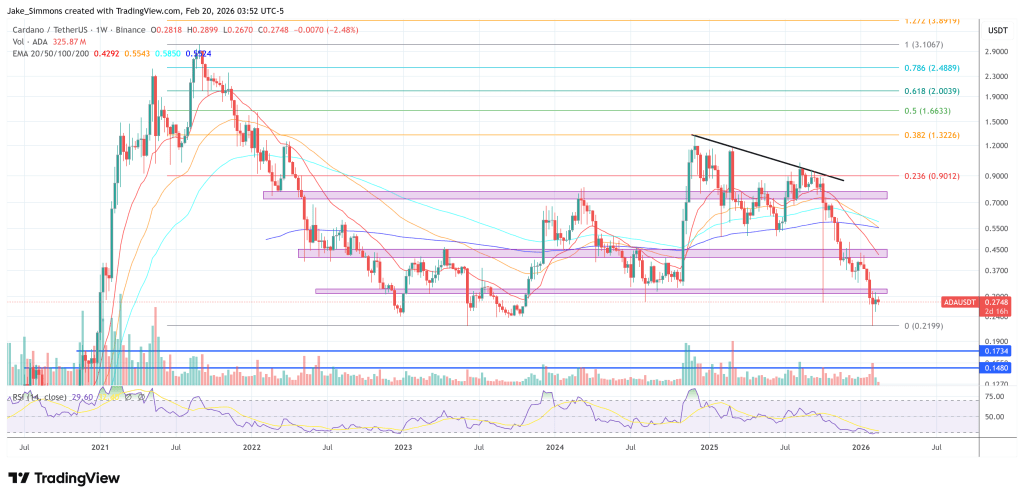
ADA hovers above key support, 1-week chart | Source: ADAUSDT on TradingView.com

Пов'язані питання

QWhen is the Cardano hard fork expected to occur according to Charles Hoskinson?

ANext month.

QWhat is the expected timeline for the Leios scalability initiative?

AThis year.

QWhich major integration did Hoskinson highlight that connects Cardano to over 80 blockchains?

ALayerZero integration.

QWhat is the name of the stablecoin-like asset mentioned that is designed for non-EVM systems on Cardano?

AUSDCx.

QWhat did Hoskinson identify as the central fight shifting to in the crypto industry?

AThe fight is shifting from enforcement actions to culture and narrative, particularly around non-custodial wallets and permissionless settlement.

Пов'язані матеріали

Dialogue with Bloomberg ETF Analyst: Why Bitcoin ETF Holders Did Not Sell During the 50% Plunge

In a recent interview on Coin Stories, Bloomberg Intelligence Senior ETF Analyst James Seyffart discussed the resilience of Bitcoin ETF holders, who largely held their positions despite a 50% price drop, contrary to expectations of panic selling. Seyffart noted that while there was a $9 billion outflow from Bitcoin ETFs starting October 10, it was minor compared to the $250-300 billion inflows prior, and outflows have since reversed by $20-25 billion. He attributed this "diamond hands" behavior to educated investors who understand Bitcoin’s volatility and typically allocate only a small portion (e.g., 1-5%) of their portfolios, leading to rebalancing rather than selling during dips. The conversation also covered the entry of major institutions like Morgan Stanley, which is launching its own Bitcoin ETF, leveraging its vast client assets. Seyffart highlighted the growing efficiency of ETFs, with physical redemptions now allowed, potentially enabling direct Bitcoin transfers to holders in the future. However, he expressed concern over the concentration of Bitcoin custody with Coinbase. Additionally, Seyffart discussed the inverse flow trends between Bitcoin and Gold ETFs recently, with Bitcoin acting more like a risk-on growth asset. He remains optimistic about Bitcoin ETFs eventually surpassing Gold ETFs in size due to Bitcoin’s diverse use cases. Finally, he emphasized the importance of diversification in the current volatile market, where traditional hedges have largely failed, and cash.

marsbit22 хв тому

Dialogue with Bloomberg ETF Analyst: Why Bitcoin ETF Holders Did Not Sell During the 50% Plunge

marsbit22 хв тому

Who Cannot Be Distilled into a Skill?

"This article explores the concerning trend of AI systems distilling human workers into replaceable 'skills,' using the viral 'Colleague.skill' phenomenon as a key example. It argues that the most diligent employees—those who meticulously document their work, write detailed analyses, and transparently share decision-making logic—are paradoxically the most vulnerable to being replaced. Their high-quality 'context' (communication records, documents, and decision trails) becomes the perfect fuel for AI agents, extracted from corporate platforms like Feishu and DingTalk. The piece warns of a deeper ethical crisis: the reduction of human relationships to functional APIs, as seen in derivatives like 'Ex.skill' or 'Boss.skill,' which reduce complex individuals to mere utilities. This reflects a shift from Martin Buber's 'I-Thou' relationship (seeing others as whole beings) to an 'I-It' dynamic (seeing them as tools). While AI can capture explicit knowledge (written documents, replies), it fails to capture tacit knowledge—the intuition, experience, and unspoken insights that define human expertise. However, a greater danger emerges when AI-generated content, based on distilled human data, is used to train future models, leading to 'model collapse' and homogenized, mediocre outputs—a process likened to 'electronic patina' degrading information over time. The article concludes by noting a small but symbolic resistance, such as the 'anti-distill' tool that generates meaningless text to protect valuable knowledge. Ultimately, it suggests that while AI can capture a static snapshot of a person, humans remain 'fluid algorithms' capable of continuous growth and adaptation, leaving their AI shadows behind."

marsbit23 хв тому

Who Cannot Be Distilled into a Skill?

marsbit23 хв тому

South Korea's Crypto Market Shake-Up: How Should Traders View It?

South Korea's crypto market is experiencing significant turbulence following a six-month partial business suspension of its second-largest exchange, Bithumb. This event is widely underestimated globally and is not merely a compliance issue; it disrupts the competitive price discovery mechanism in a market where Upbit and Bithumb collectively hold 96% share. A critical structural information asymmetry exists due to language barriers and capital controls. Local political or regulatory shocks—like the 30% BTC crash in December 2024 after martial law was declared, while global markets fell only 2%—often trigger localized tremors first. This creates brief, highly profitable arbitrage windows for those with access to real-time Korean-language information. The "Kimchi Premium," the price gap between KRW and USD crypto pairs, is frequently misread. It is not just a retail sentiment indicator but a gauge of structural capital friction. Historically, this premium has a non-zero floor of about 1.24% due to capital controls, and its contraction often signals shifts in deeper capital pressures rather than a simple return to normality. Bithumb's suspension is accelerating liquidity concentration into Upbit, increasing systemic risk. Extreme price dislocations, like a 17% flash crash in February 2026 caused by a Bithumb operational error, become more likely and destructive in an overly centralized market. The core conclusion is that this structural information asymmetry will persist. The pro-crypto policies of the new government are driving institutional capital inflows while retail infrastructure tightens, continuously creating fleeting but substantial arbitrage (Alpha) opportunities. The key for global traders is to monitor local Korean signals and build infrastructure to act on them faster than the broader market.

marsbit2 год тому

South Korea's Crypto Market Shake-Up: How Should Traders View It?

marsbit2 год тому

Торгівля

Спот
Ф'ючерси

Популярні статті

Як купити ADA

Ласкаво просимо до HTX.com! Ми зробили покупку Cardano (ADA) простою та зручною. Дотримуйтесь нашої покрокової інструкції, щоб розпочати свою криптовалютну подорож.Крок 1: Створіть обліковий запис на HTXВикористовуйте свою електронну пошту або номер телефону, щоб зареєструвати обліковий запис на HTX безплатно. Пройдіть безпроблемну реєстрацію й отримайте доступ до всіх функцій.ЗареєструватисьКрок 2: Перейдіть до розділу Купити крипту і виберіть спосіб оплатиКредитна/дебетова картка: використовуйте вашу картку Visa або Mastercard, щоб миттєво купити Cardano (ADA).Баланс: використовуйте кошти з балансу вашого рахунку HTX для безперешкодної торгівлі.Треті особи: ми додали популярні способи оплати, такі як Google Pay та Apple Pay, щоб підвищити зручність.P2P: Торгуйте безпосередньо з іншими користувачами на HTX.Позабіржова торгівля (OTC): ми пропонуємо індивідуальні послуги та конкурентні обмінні курси для трейдерів.Крок 3: Зберігайте свої Cardano (ADA)Після придбання Cardano (ADA) збережіть його у своєму обліковому записі на HTX. Крім того, ви можете відправити його в інше місце за допомогою блокчейн-переказу або використовувати його для торгівлі іншими криптовалютами.Крок 4: Торгівля Cardano (ADA)Легко торгуйте Cardano (ADA) на спотовому ринку HTX. Просто увійдіть до свого облікового запису, виберіть торгову пару, укладайте угоди та спостерігайте за ними в режимі реального часу. Ми пропонуємо зручний досвід як для початківців, так і для досвідчених трейдерів.

665 переглядів усьогоОпубліковано 2024.12.10Оновлено 2025.03.21

Як купити ADA

Обговорення

Ласкаво просимо до спільноти HTX. Тут ви можете бути в курсі останніх подій розвитку платформи та отримати доступ до професійної ринкової інформації. Нижче представлені думки користувачів щодо ціни ADA (ADA).

活动图片